

Only logged in customers who have purchased this product may leave a review.
Availability: Available immediately
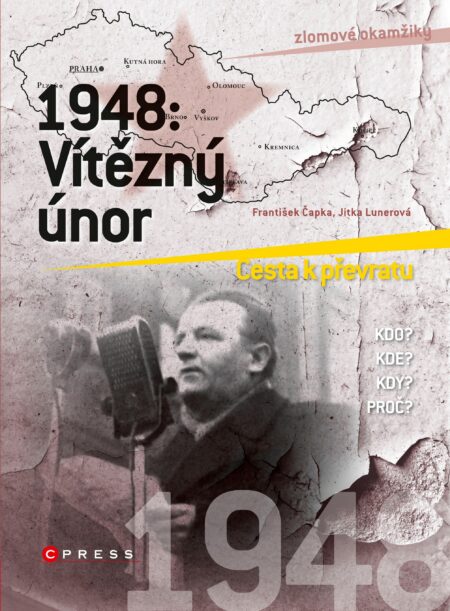
1948: Vítězný únor
Author: František Čapka, Jitka Lunerová
9,96 €
František Čapka and Jitka Lunerová revisit February 1948 by asking how the shift in power gradually came about. Their historical study looks beyond a few days of crisis to the preceding postwar years. Domestic politics intersects with the international setting and the decisions of specific participants. The book suits readers seeking a coherent overview supported by chronology. Documents, photographs, and maps complement its account of the causes and consequences of the communist takeover.
Six sections lead from the end of World War II to the February government crisis. This structure makes it possible to follow which conditions developed over time and which decisions had an immediate effect. Rather than an isolated moment, readers encounter a sequence of political and social changes.
The book distinguishes the roles of individuals and connects events in Czechoslovakia with the international scene. Documentary material complements the narrative with traces of the period, while the chronology clarifies the timing of actions and responses.
The closing question of whether this course of events could have been prevented invites historical reflection. It is a way of examining participants’ decisions and options, rather than a definitive account of an alternative past. The value lies in connecting the causes, course, and long-term consequences of a turning point that shaped the decades that followed.
František Čapka and Jitka Lunerová revisit February 1948 by asking how the shift in power gradually came about. Their historical study looks beyond a few days of crisis to the preceding postwar years. Domestic politics intersects with the international setting and the decisions of specific participants. The book suits readers seeking a coherent overview supported by chronology. Documents, photographs, and maps complement its account of the causes and consequences of the communist takeover.
Book information
- Author
- František Čapka, Jitka Lunerová
- Publisher
- Albatros Media a.s.
- Imprint
- Cpress
- Formát
- E-book
- Language
- Czech
- Genre
- History, Moderné dejiny
- ISBN
- 978-80-264-0089-9
- Pages
- 152
- E-book formats
- EPUB (ISBN 978-80-264-0226-8) · PDF (ISBN 978-80-264-0225-1) · MOBI (ISBN 978-80-264-0227-5)
What is 1948: Vítězný únor about?
Six sections lead from the end of World War II to the February government crisis. This structure makes it possible to follow which conditions developed over time and which decisions had an immediate effect. Rather than an isolated moment, readers encounter a sequence of political and social changes.
The book distinguishes the roles of individuals and connects events in Czechoslovakia with the international scene. Documentary material complements the narrative with traces of the period, while the chronology clarifies the timing of actions and responses.
The closing question of whether this course of events could have been prevented invites historical reflection. It is a way of examining participants’ decisions and options, rather than a definitive account of an alternative past. The value lies in connecting the causes, course, and long-term consequences of a turning point that shaped the decades that followed.
Themes and motifs
Postwar conditions
February is explained in relation to preceding developments.
The roles of participants
The account follows specific political decisions and their consequences.
Causes and possibilities
The question of inevitability encourages critical historical reflection.
Setting
Czechoslovakia, primarily from the end of World War II to February 1948.
Who is this book for?
For readers interested in Czechoslovakia’s postwar history and students seeking an overview supported by chronology and documents.
Book context
Masaryk University records the publication as a scholarly book from 2012 and states that it was based on the study of archival documents. Bibliographic records confirm the subtitle Cesta k převratu and first publication in 2012.
Otázky o knihe
What is 1948: Vítězný únor about?
František Čapka and Jitka Lunerová revisit February 1948 by asking how the shift in power gradually came about.
What language is this edition in?
This edition is in Czech.
Which e-book formats are available?
EPUB, PDF, MOBI.
Does the book cover only the days of the February crisis?
No. It also covers the postwar years, domestic and international contexts, and the causes and consequences of the crisis.



Reviews
There are no reviews yet.