
Only logged in customers who have purchased this product may leave a review.
Preview
Availability: Available immediately
Myšlenkové mapy
Author: Barry Buzan, Tony Buzan
11,96 €
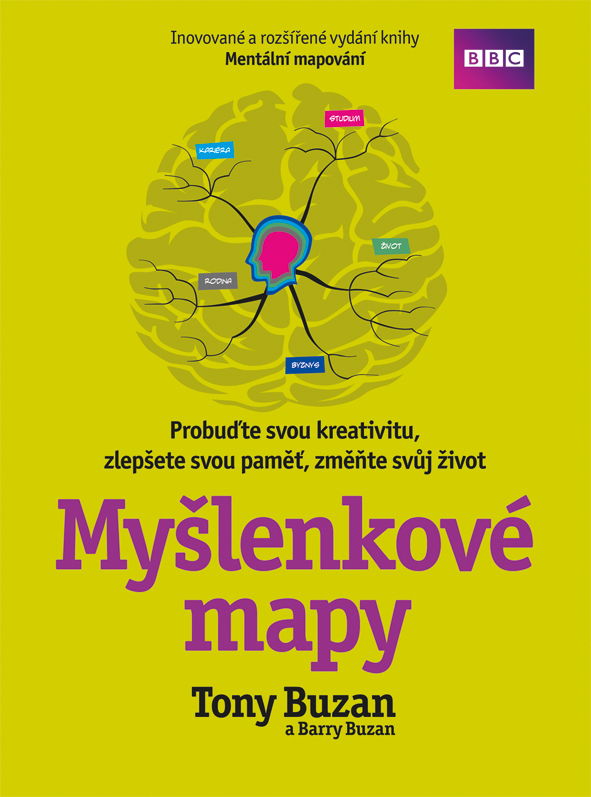
Myšlenkové mapy by Tony and Barry Buzan presents a method for visually organizing information, ideas, and connections. The book shows how mind maps can be used for learning, memorization, planning, problem-solving, preparing presentations, and organizing personal and professional tasks. The authors combine words, images, numbers, logic, colors, and space in a technique intended to support creative thinking and a clearer approach to information.
The book explains the principles of mind mapping and its practical uses in different areas of life. Readers learn to record and organize information around a central topic, developing it through branches, keywords, and visual elements. The method can be used for taking notes, studying, preparing for exams, planning texts and presentations, solving problems, making decisions, and organizing projects or personal goals. The book emphasizes creativity, memory, concentration, communication, and the ability to see relationships between pieces of information. The Czech edition belongs to the Knihy o mozku publishing collection and is based on the English-language work The Mind Map Book.
Visual branching allows a topic to be seen as a network of relationships. When studying, readers can distinguish information that shares a common core from separate subtopics. When planning, a map can display several possibilities side by side. The explanation connects the form of the notes with how readers revisit, expand, and use information for a specific task.
Book themes
Mind maps: The book explains the principles of creating and using visually structured mind maps.
Creativity: The method is intended to support the generation, connection, and development of ideas.
Memory: The authors show how mind maps can be used to memorize and recall information.
Concentration and learning: Mind mapping is used to organize notes, study, and work more clearly with learning material.
Planning: The technique can be used to prepare projects, presentations, texts, and personal goals.
Organizing information: The visual structure helps show relationships between topics and subtopics.
Who the book is for
Students, educators, managers, professionals, and other readers who want to use visual techniques for learning, planning, organizing information, and creative work.
Edition context
The Mind Map Book is an internationally published guide by Tony and Barry Buzan. English editions date from the 1990s. The Czech edition with ISBN 978-80-265-0030-8 has 216 pages, was published by BizBooks, and belongs to the Knihy o mozku collection. SOURCE_FACT covers the 2014 electronic version with PDF ISBN 978-80-265-0198-5.
Myšlenkové mapy by Tony and Barry Buzan presents a method for visually organizing information, ideas, and connections. The book shows how mind maps can be used for learning, memorization, planning, problem-solving, preparing presentations, and organizing personal and professional tasks. The authors combine words, images, numbers, logic, colors, and space in a technique intended to support creative thinking and a clearer approach to information.
Book information
- Author
- Tony Buzan, Barry Buzan
- Publisher
- Albatros Media a.s.
- Imprint
- BizBooks
- Formát
- E-book
- Language
- Czech
- Genre
- Personal Development, Myšlienkové mapy, Kreativita, Pamäť, Učenie a produktivita
- Original title
- The Mind Map Book
- ISBN
- 978-80-265-0030-8
- Publication date
- 23. April 2014
- Pages
- 216
- Edition
- Knihy o mozku
- E-book formats
- PDF (ISBN 978-80-265-0198-5)
What is Myšlenkové mapy about?
The book explains the principles of mind mapping and its practical uses in different areas of life. Readers learn to record and organize information around a central topic, developing it through branches, keywords, and visual elements. The method can be used for taking notes, studying, preparing for exams, planning texts and presentations, solving problems, making decisions, and organizing projects or personal goals. The book emphasizes creativity, memory, concentration, communication, and the ability to see relationships between pieces of information. The Czech edition belongs to the Knihy o mozku publishing collection and is based on the English-language work The Mind Map Book.
Visual branching allows a topic to be seen as a network of relationships. When studying, readers can distinguish information that shares a common core from separate subtopics. When planning, a map can display several possibilities side by side. The explanation connects the form of the notes with how readers revisit, expand, and use information for a specific task.
Themes and motifs
Mind maps
The book explains the principles of creating and using visually structured mind maps.
Creativity
The method is intended to support the generation, connection, and development of ideas.
Memory
The authors show how mind maps can be used to memorize and recall information.
Concentration and learning
Mind mapping is used to organize notes, study, and work more clearly with learning material.
Planning
The technique can be used to prepare projects, presentations, texts, and personal goals.
Organizing information
The visual structure helps show relationships between topics and subtopics.
Who is this book for?
Students, educators, managers, professionals, and other readers who want to use visual techniques for learning, planning, organizing information, and creative work.
Book context
The Mind Map Book is an internationally published guide by Tony and Barry Buzan. English editions date from the 1990s. The Czech edition with ISBN 978-80-265-0030-8 has 216 pages, was published by BizBooks, and belongs to the Knihy o mozku collection. SOURCE_FACT covers the 2014 electronic version with PDF ISBN 978-80-265-0198-5.
Otázky o knihe
What are mind maps?
They are visual structures that organize information around a central topic using branches, keywords, images, and other elements.
Who wrote Myšlenkové mapy?
The authors of the work covered here are Tony Buzan and Barry Buzan.
What is the book's original title?
The original English title is The Mind Map Book.
What can mind maps be used for?
The book presents them as a tool for learning, taking notes, planning, memorization, creative thinking, problem-solving, and organizing information.
Is the book part of a publishing collection?
Yes. The Czech edition belongs to the Knihy o mozku collection.
How many pages does the Czech edition have?
Both SOURCE_FACT and the official publisher give 216 pages.
What format is this e-book available in?
SOURCE_FACT lists PDF with ISBN 978-80-265-0198-5.
When did the original work appear?
English editions of The Mind Map Book are bibliographically documented from the 1990s; the 2014 date in SOURCE_FACT refers to the electronic edition covered here.
Can mind maps also help with preparing presentations?
The book lists planning texts and presentations and organizing related ideas among their uses.




Reviews
There are no reviews yet.